
Getting Douglas County Court Records
Gather the basics first: case number, caption, court, and the document's name or date. The public JUSTICE system may display a document image right there. Is the image missing? Do you need certification? Then go to the clerk of the court that keeps the file. Douglas splits the clerk work among District Court, County Court, and Separate Juvenile Court. Also know the difference between a simple named-file request and a formal public-records request. They follow different tracks.
- Search the public case record by case number or party name and save the court and caption.
- Check whether a public image is available through JUSTICE or at a courthouse terminal.
- Use the correct clerk counter, phone line, mail route, or electronic form for the exact document.
- Complete CC 3:29 for copies or certification and prepay the stated cost.
- Use a written Nebraska Public Records Act request for an extensive non-online record when that route is needed.
The eServices case-information page lays out the online and courthouse options for searching. It opens an index and image path, though it does not promise every piece of a Douglas County court file is online.
Douglas County Clerk Record Routing
Send your request to whichever court owns the case. Crystal Rhoades is the District Court Clerk. She handles District matters at the Hall of Justice, 1701 Farnam Street, reachable at 402-444-7018 as listed by the court. Pam Cardenas serves as County Court Clerk. Her office covers traffic, misdemeanor, probate, small claims, county civil, and preliminary felony material. The numbers differ by division. County Court lists 402-444-5387, Civil and Small Claims lists 402-444-5424, and Probate lists 402-444-7152.
Douglas County District Court Clerk
District felony, civil, domestic, protection-order, administrative-appeal, and district problem-solving records.
Hall of Justice, 1701 Farnam Street, Omaha, NE 68183
402-444-7018
Douglas County Court Clerk
Traffic, municipal ordinance, misdemeanor, probate, small claims, county civil, and preliminary felony records.
Hall of Justice, 1701 Farnam Street, Omaha, NE 68183
402-444-5387
The official Fourth Judicial District directory maps the clerk structure and lists contacts. For juvenile files, use the Separate Juvenile Court clerk, and expect separate confidentiality rules.
Court Record Types
A court record is more than the Register of Actions. The clerk's file might sit on paper, microfilm, or an electronic image. It might be restricted entirely. JUSTICE shows the chronological register plus most filed images, but not everything. Name the document you want. Asking for an undefined case file slows things down. That happens when you need a specific order, pleading, judgment, or hearing item.
- Register of Actions and Case Detail.
- Pleadings, motions, and filed responses.
- Orders, judgments, and signed rulings.
- Criminal offense, payment, and disposition material.
- Probate, small-claims, civil, and traffic case documents.
Douglas County Court File Register
The Register of Actions works as an event index. It tells you a complaint, motion, hearing, order, or judgment happened. Yet it is not the document itself. A public image may supply the text. When it does not, CC 3:29 is the copy and certification route. Older files may need clerk help, since Douglas court records can live on paper, microfilm, or image. The official court-records search policy also lists public courthouse terminals. Those terminals help when an online record runs thin. They also help when you already hold the exact case number.
Inside a Douglas County Court Record
A case file pairs identifiers with source documents. Read the caption, court, number, and date first. The Register of Actions then puts each pleading and order in sequence. One caution: a judgment entry may report a result, while the signed judgment carries the full text.
| Case number | The court, case type, year, and sequence reference for locating the file. |
|---|---|
| Caption and parties | The formal case name and party roles. |
| Register of Actions | Chronological filings, hearings, continuances, and orders. |
| Pleadings | Documents such as complaints, petitions, answers, and motions. |
| Orders and judgments | Signed rulings, dispositions, and judgment documents. |
Douglas County Court Record CC 3:29
The official CC 3:29 copy-request page opens the request route. It covers file copies and certified copies. The form wants the county, case number, case name, document name or date, copy type, delivery choice, contact information, signature, and attorney bar number when applicable. Four choices exist: electronic non-certified, mailed non-certified, electronic certified, and mailed certified.
Describe the document with precision. Pick your delivery and certification option before sending. Costs are prepaid. The form makes no turnaround promise, so ask the clerk about local status or payment practice. The Judicial Branch's CC 3:29 form spells out those delivery choices.
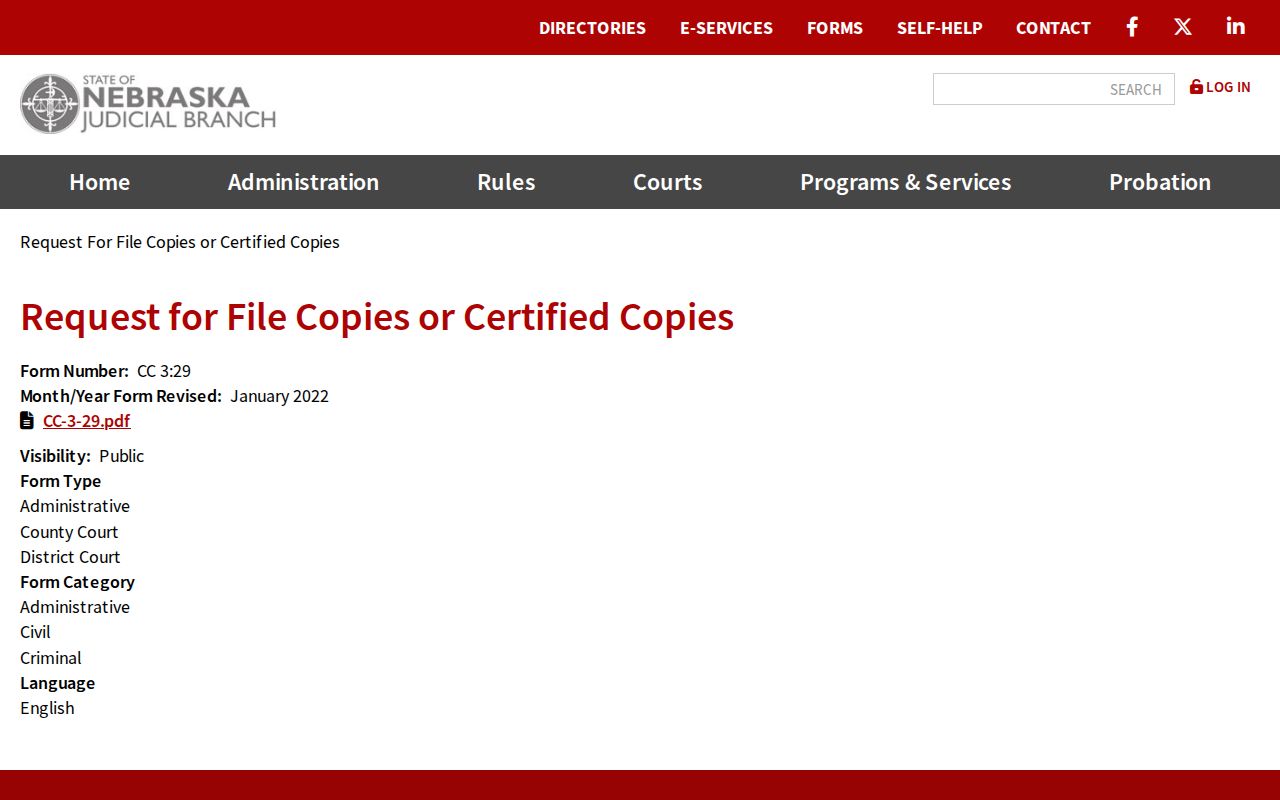
A Douglas County copy request goes fastest with a full case and document description. The form itself shows what the clerk needs from you.
Fees and Certified Copies
Plain and certified copies serve different purposes. The clerk issues a certified copy with a certification or seal attached. Per the current state schedule and CC 3:29, the costs below apply. Card fees can add on. Note that a $17 JUSTICE name search is not a certified judgment.
| Item | Amount | Request path |
|---|---|---|
| Electronic non-certified copy | No charge | CC 3:29, when the copy can be delivered electronically. |
| Mailed non-certified copy | $0.25 per page | CC 3:29 with prepaid copy cost. |
| Electronic certified copy | $1 per request | CC 3:29 certification selection. |
| Mailed certified copy | $1 per seal plus $0.25 per page | CC 3:29 certification and mail selection. |
| Authenticated three-seal certificate | $3 | Ask the clerk whether this form of authentication applies. |
The filing-fee and court-cost schedule supplies the current state fee entries.
The official Douglas County Court page identifies the County Court divisions that handle those files.
One call to the County Court can route a copy request correctly. A Douglas County traffic, probate, small-claims, or county civil docket request just needs the right clerk, and the court's own page points the way.
Douglas County Court Record Transcript
A transcript is its own animal, not a photocopy. CC 1:14 asks for the county, case number or name, and hearing date. Time, location, judge, full or partial hearing, and exhibit information also go on the request. Requester details and attorney bar number complete the list. Parties and counsel may request one directly. A nonparty needs trial-judge approval. The reporter or private transcriber gives an estimate. Payment comes before preparation, and a rush charge may apply.
County digital audio, where available and unrestricted, runs $10 for the first hearing on one CD. Each added hearing on that CD is $5, and $5 covers each additional CD. The official typed-transcript instructions walk through the separate request path.
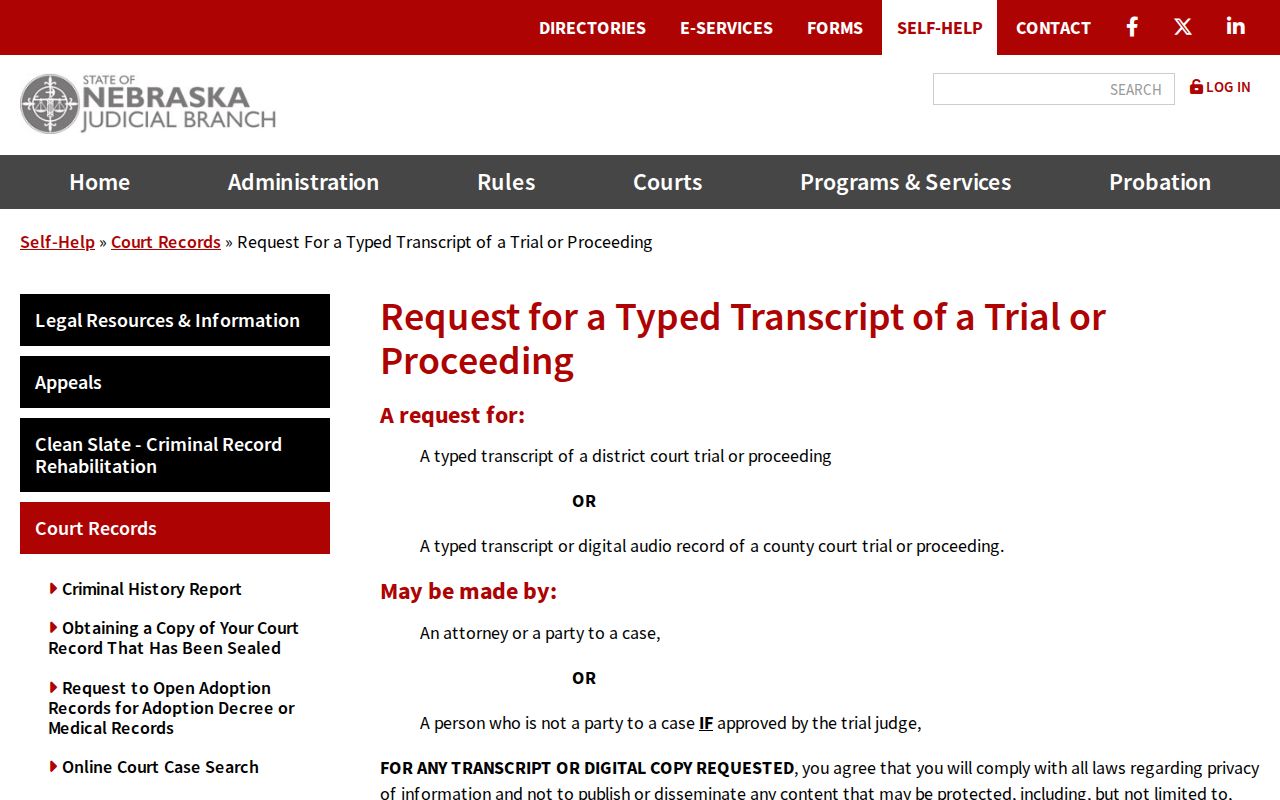
Those transcript instructions make one thing clear: a Douglas County hearing record needs its own request, estimate, and access review.
Douglas County Record Media
Scanned clerk files exist for Douglas County from 1997 forward. That history does not promise every current file is imaged. The District Court rule allows paper, microfilm, and electronic records. The medium depends on the case and its age. Before paying for copies on an older case, ask the clerk two things. What medium does the record sit in? Does retrieval take extra time or cost? A case index can be public. The underlying record may rest on a different storage format entirely.
The records-retention schedules govern how long each record type is kept. That is why local clerk help still matters for older material.
State law frames what counts as a record, too. Nebraska Revised Statute 84-712.01 defines public records to include computer data. An electronic docket entry is therefore as much a public record as a paper file.
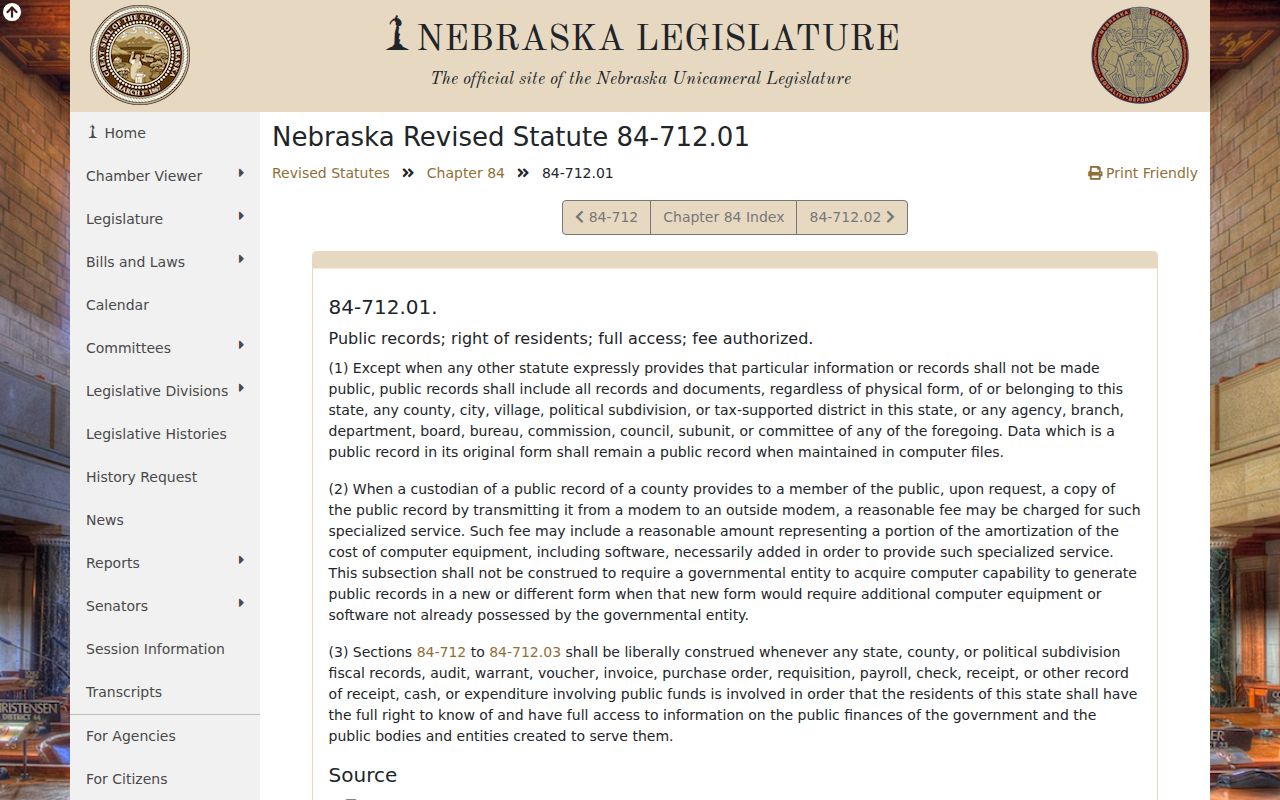
That statute page sets out what Nebraska counts as a public record. Computer data sits on the list, so a Douglas County court record request can reach electronic files as well as paper ones.
Sealed Records and Public Access
Nebraska's access rules open a wide door to court material. Indexes, summaries, Registers of Actions, calendars, and available images are all public, within stated limits. The rules also shield certain content. Protected personal and financial data, juvenile files, sealed material, victim information, medical records, and protected addresses may be withheld or redacted. Keep one point in mind when a Douglas County court docket shows no image. A missing image proves nothing about whether the case or the document exists.
Key rules: Nebraska Revised Statute 84-712 provides public inspection and copying subject to exceptions and a written-request response path. Section 1-805 describes public electronic court access. Section 43-2,108 protects juvenile files and identifying information.
Douglas County Sealed Record Requests
Form DC 1:12 exists for one narrow purpose. It releases a record that the requester's own sealed file contains. It is not a discovery tool. You cannot use it to reach into another person's sealed case. The form asks for a case number, the requester's details, the release recipient, and a document or full-file choice. It also wants the payer, a delivery choice, contact information, identification, notary verification, and a signature. Once filed, the clerk confirms cost, delivery, certification, timing, and any deposit.
A different path covers an extensive record that is not online. A written Public Records Act request brings access, a lawful denial, or an estimate within four business days. The court search policy sends that formal request to the State Court Administrator. The official Public Records Act source lays out the four-business-day written-request framework in full.
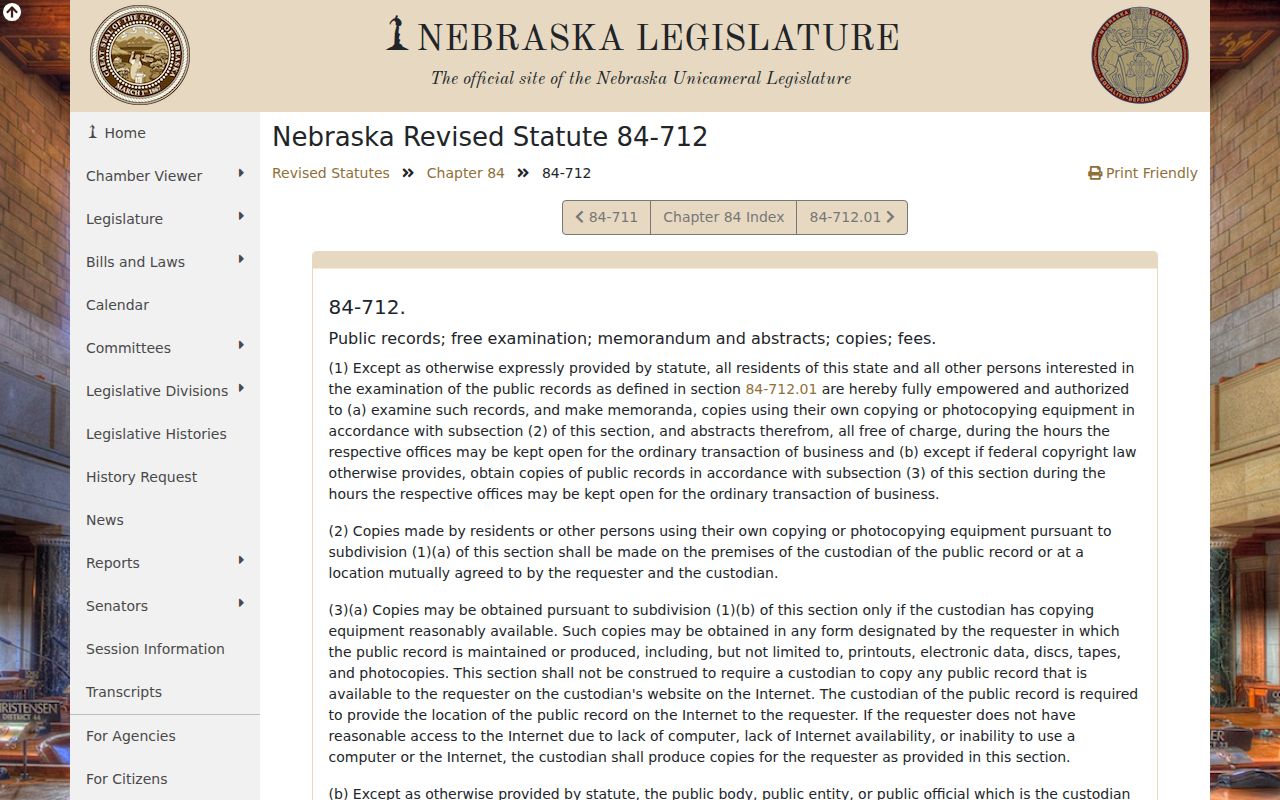
The statute treats the formal public-records request as one option among several. A direct clerk copy request in Douglas County still stands on its own, separate from that statutory route.
Douglas County Court Record Access Channels
No single door leads to Douglas County court records. JUSTIENCE is not the word; JUSTICE is the statewide system, offering public case information and many document images. A terminal at the courthouse gives an in-person search route. The clerk handles counter copy requests, answers phone questions about local routing, and accepts a completed request form. CC 3:29 lays out the electronic and mailed copy choices. An extensive record that is not online can go through the formal Public Records Act path instead.
Match the channel to the goal. Need only the case number? Start online or at a terminal. Need the signed order itself? Name that document on CC 3:29. A court-certified copy requires selecting certification before you prepay. When a docket entry appears with no record behind it, the clerk is the right contact, because the file may simply sit in a different medium.
Douglas County Court Record Redaction
Even a fully public case has edges. Nebraska rules protect birth dates, gender, and Social Security numbers. Financial-account numbers, protected addresses, and similar information are shielded as well. Redaction removes content from public view. It does not erase the underlying event from the court's record. Juvenile confidentiality and sealing add further limits on top of that.
The distinction matters when you compare a Register of Actions against the documents behind it. An event can stay visible while its image stays hidden. No request slips past a seal, a redaction, or the court's own access determination. Ask the clerk about the available procedure. Trying to reconstruct protected details from a partial public view is the wrong road.